The world exists in a delicate balance of four primal forces: Fire, Water, Air, and Earth. For centuries, these elements have been harnessed by a select few, the Elemental Forgers, to shape and command the world. In this game, you assume the role of one such Forger, a master artisan who must draw upon the raw power of the elements and combine them into something greater than the sum of their parts. The objective is not merely to amass power, but to achieve a state of complete elemental ascendancy, outmaneuvering and out-thinking your rivals in a dynamic, high-stakes contest of wits and luck. This game combines strategic card play, calculated risk, and a dash of luck, all within a compact, engaging experience designed for 30 to 60 minutes of intense competition.
The primary goal of Elemental Forge is to be the first player to achieve a score of 100 points. The game concludes immediately when a player reaches or exceeds this point threshold at the end of their turn, granting them a definitive victory. This clear and singular objective provides a focused pathway to victory, allowing players to align their strategic decisions with a well-defined end goal. All actions taken during the game, from drawing cards to launching a dice attack, should be viewed through the lens of this final objective.
Before beginning, ensure you have all the necessary components for your journey as an Elemental Forger. The game includes:
A crucial part of understanding the game is familiarity with the cards themselves. The values are as follows: Aces are worth 1 point; cards from 2 through 10 are worth their face value; and Jacks, Queens, and Kings are each worth 10 points. For quick reference, examine Figure 1: Anatomy of a Card for a visual breakdown of the card attributes used in the game. This diagram highlights the card's value, suit, and color, which are all integral to the elemental combinations you will forge.
To set up the game, follow these steps in the specified order to ensure a smooth and clear start. A visual representation of the final setup is provided in Figure 2: Game Setup to assist you.
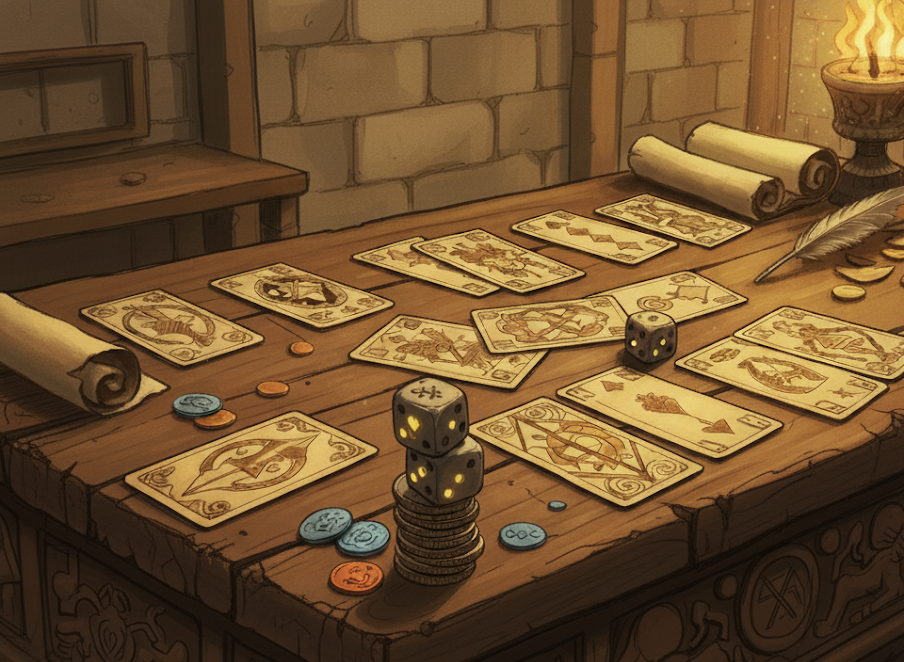
As you begin your game, your hand of five cards is your private set of resources. The cards in your hand are the raw materials you will use to create elemental combinations. The Forge Pile, on the other hand, is a public space. The card at the top of the Forge Pile is the card you must combine with on your turn to create a new element. The dynamic between your private hand and the public Forge Pile is a fundamental element of the game's strategy, requiring careful consideration of your available cards versus the constantly changing public card.
The game proceeds in a clockwise fashion, with each player taking a single turn before passing the action to the next player. On your turn, you must choose and perform one of three distinct actions. The simplicity of this turn structure is a core design choice, as it minimizes downtime and keeps the game moving at a brisk pace. Your choices are clear and consequential, each providing a different avenue for progress. For a visual overview of a typical turn, see Figure 3: Turn Flowchart, which uses standard flowchart symbols to illustrate the decision points and actions.
This is the most straightforward action available to you. By choosing the Draw Action, you take the top two cards from the Draw Deck and add them to your hand. This is a fundamental action for resource acquisition, allowing you to build up a larger hand and increase your chances of finding powerful card combinations in future turns.
This action is the heart of Elemental Forge. By choosing this action, you play a pair of cards of the same rank from your hand onto the Forge Pile to create an elemental combination. The combination's value is the sum of the two cards' point values, and this newly created value is immediately added to your total score. For example, combining a 5 of Hearts with a 5 of Diamonds creates a 10-point Fireball, and you add 10 to your score. The cards you played become the new top cards of the Forge Pile, and the original top card is placed at the bottom of the Draw Deck. This mechanism ensures the Forge Pile is in a constant state of flux, forcing you to adapt your strategy to the available combinations. The game's design makes achieving high-value combos a central strategic goal, as they are not only key for scoring but also for unleashing the game's most powerful abilities. The difficulty of attaining these combos is balanced by their powerful effects, creating a high-risk, high-reward dynamic that is core to the game's strategy.
| Combination | Element Name | Point Value | Special Effect |
|---|---|---|---|
| Two Red Cards (Hearts & Diamonds) of the same rank. | Ignite | Sum of two cards | You may immediately discard one card from your hand, then force every other player to reveal their hand and discard their highest-value card. You draw one card for each card discarded this way. |
| Two Black Cards (Spades & Clubs) of the same rank. | Hydroblast | Sum of two cards | You can choose to draw one extra card from the deck. Additionally, you may take one card from the bottom of the discard pile and add it to your hand. |
| Two Red Cards of the same suit (two Hearts or two Diamonds) of the same rank. | Quake | Sum of two cards | You can force all players to discard one card from their hand, and they cannot draw a new card on their next turn. |
| Two Black Cards of the same suit (two Spades or two Clubs) of the same rank. | Gust | Sum of two cards | You may then swap one card from your hand with a card in another player's hand. After the swap, you may look at the top three cards of the Draw Deck, rearrange them in any order you choose, and then draw the top card. |
The careful and consistent use of this table will prove invaluable as you learn the game.
This action allows you to fine-tune your hand to prepare for future turns. By choosing this action, you may discard any number of cards from your hand and then draw the same number of cards from the Draw Deck. This is a powerful move for hand management, particularly if you have a hand of low-value or mismatched cards that prevent you from forming strong combinations. It serves as a vital recovery mechanic, particularly after a disruptive elemental effect, such as a Quake attack, has forced you to lose cards from your hand. The ability to use an entire turn to recover and rebuild your hand provides a critical defensive option against card disruption, ensuring that players are not completely helpless when facing powerful opponent abilities. This creates a balanced, back-and-forth dynamic where powerful offense is met with a clear and effective defensive counter-play.
The true strategic depth of Elemental Forge lies in the unique abilities tied to each element. These effects are not just a bonus; they are tactical tools that can fundamentally change the flow of the game.

The Catalyst Card is represented by the Joker and is an incredibly valuable resource in Elemental Forge. When you combine a Catalyst Card with any other card from your hand, it doubles the value of the card it is combined with. For example, a Catalyst Card combined with a 7 of Hearts creates a 14-point Ignite combo, which is added to your score. The Catalyst Card, however, does not possess its own special effect; it only grants the effect of the card it combines with.
This design choice creates a critical strategic decision point for players. The Catalyst Card is a source of immense raw point-efficiency, allowing for a rapid ascent to the 20-point goal. However, using it for a large point surge means forgoing the tactical utility of the elemental effects. For example, a player must choose between using two normal cards to achieve a targeted Ignite attack, or using the Catalyst Card to score a massive point gain. This creates a compelling trade-off between tactical disruption and raw scoring power, a dynamic that is at the heart of the game's balance and replayability.
After you successfully create an elemental combination, you have the option to use the dice to "attack" another player. The power of your attack is directly tied to the point value of the combination you just created, introducing a system where strategic card play is directly rewarded with a powerful offensive option. This mechanic is a core principle of the game, linking strategic effort to offensive capability.
To master Elemental Forge, one must move beyond simply understanding the rules and begin to comprehend the strategic value of each action and element. Every action you take is a decision between a known value and a potential future benefit. The Draw action is a form of investment, sacrificing a turn to increase your potential for a high-value combo. The Draw and Discard action is a recovery tool, a tempo play that allows you to reset your hand after a disruption. The true strategic depth lies in the interplay between elemental abilities. A powerful Quake can be a game-winning play if it forces an opponent to discard their winning combination. However, its indiscriminate nature means it will also affect your own hand and can unintentionally help an opponent who was holding a hand of unwanted cards. Conversely, Gust is a precise, targeted ability that can steal a crucial card from a leading player, but it has no effect on the other players at the table. This game rewards flexible thinking and the ability to adapt to a changing board state. A player who only focuses on scoring points with high-value combos may quickly find themselves the target of multiple dice attacks, while a player who focuses solely on disruption may fall behind in the race to 20 points. The key is to find a balance between accumulating points and tactically controlling the game through your chosen elemental effects.
This section addresses common questions and potential rule conflicts to ensure a smooth and fair playing experience.
The game concludes when a player reaches or exceeds a score of 100 points at the end of their turn. That player is the victor and is recognized as the master Forger of the Elements. The game offers a dynamic and strategic experience where every decision carries weight. Good luck, and may the elements be ever in your favor.